Most buyers relocating to Cheyenne assume the radon question is a health checkbox. Test the house, get a number, move on. That framing misses what the number is actually doing inside a Wyoming transaction.
Here is the mechanic worth understanding before you sign anything: in a state that does not require a seller disclosure form, the radon test is one of the few pieces of information you can put on paper during the contingency period. That makes it a pricing tool, not just a safety one.
The disclosure gap that changes the math
Wyoming is a caveat emptor state. Wyoming is a caveat emptor state, also known as a buyer-beware state, and home sellers aren't required by state law to fill out a seller disclosure form to share with potential buyers. That is the baseline most out-of-state buyers do not expect, because roughly forty other states require some version of a written property condition report.
The gap is not total. Under Wyo. Stat. § 33-28-303(c), a licensee acting as a seller's agent shall disclose to any prospective buyer all adverse material facts actually known by the licensee. In plain terms, your listing agent cannot sit on a known radon reading of 8 pCi/L. The seller personally, without an agent involved, has a lower affirmative duty and mainly has to avoid outright fraudulent misrepresentation.
Vacant land is the exception that proves the rule. Wyoming's § 34-1-151 requires sellers of vacant land to disclose utilities, road maintenance, water and sewer availability, fire protection, easements, and mineral estate severance. Residential resale sits outside that statute.
So the buyer's side of the closing table has two facts to sit with. The seller may know nothing about radon and be legally fine. The seller may have tested years ago, gotten a bad number, and never told anyone, and unless their agent knows about it, the number stays inside the walls.
The test you order during your inspection window is how that fact becomes yours.
What Zone 1 actually predicts about your house
The EPA sorts every county in the United States into three radon zones. Every county in Wyoming is classified as Zone 1 by the EPA, indicating a high potential for elevated radon levels. Laramie County is no exception.
Zone 1 is a prediction, not a guarantee. A radon zone of 1 predicts an average indoor radon screening level greater than 4 pCi/L, which is above the recommended levels assigned by the EPA. The number 4.0 pCi/L is the action threshold. According to the EPA, any home that tests over 4.0 pCi/L should get fixed as soon as possible.
How often does that actually happen in Wyoming homes? The published estimates diverge, and it is worth naming the spread rather than picking a number that sounds cleaner.
| Source | Share of Wyoming homes above 4.0 pCi/L |
|---|---|
| Gateway Construction, citing test result aggregates | 33% |
| Radon.org state summary | Approximately 65% |
The honest read: somewhere between one in three and two in three Cheyenne homes will test high. That is a wide band, and it is exactly why a general county-level statistic cannot substitute for a test on the specific address you are about to close on. Two homes on the same street can produce different readings depending on foundation type, ventilation, and how much of the living space sits below grade.
The test that holds up at the closing table
The radon component of the Wyoming Cancer Program provides information to Wyoming residents, contractors, and real estate agents about radon, and the state agency runs a free short-term kit program. The Wyoming Department of Health offers a free home radon test kit for Wyoming residents, while supplies last.
Free kits are excellent for homeowners doing baseline monitoring. They are not the right tool for a transaction. During an inspection window you need results a buyer, seller, and lender will all accept as chain-of-custody evidence, which means a professional test.
Here is the difference in what you get:
- DIY short-term kit: costs around twenty dollars, sits in the lowest livable area for two to seven days, gets mailed to a lab. Reliable for a homeowner's own information. Not defensible if a seller pushes back on a mitigation request.
- Professional continuous monitor: placed by a certified technician, tamper-resistant, returns hourly readings. If you want highly accurate results to support a real estate transaction or after building a new house, contact a certified radon tester.
Cheyenne has real depth on the professional side. The Certified Radon Professionals registry lists Stephen Fotiades at Big Horn Radon, Howard Shedd at Certified Radon Systems, Shawn Brown at Kimbel Mechanical Systems, David Rayl at Sugarloaf Services, and Nick Lawhead at North Point Radon in Granite Canon, all NRPP-credentialed and working the Laramie County market. North Point Radon holds National Radon Proficiency Program (NRPP) and National Radon Defense (NRD) University certification.
If the number comes back high, what "fixing it" actually means
A test above 4.0 pCi/L is not a deal killer. It is a scope item. The methods are well established and depend on how the house is built.
The three approaches you will hear about during a Cheyenne inspection response:
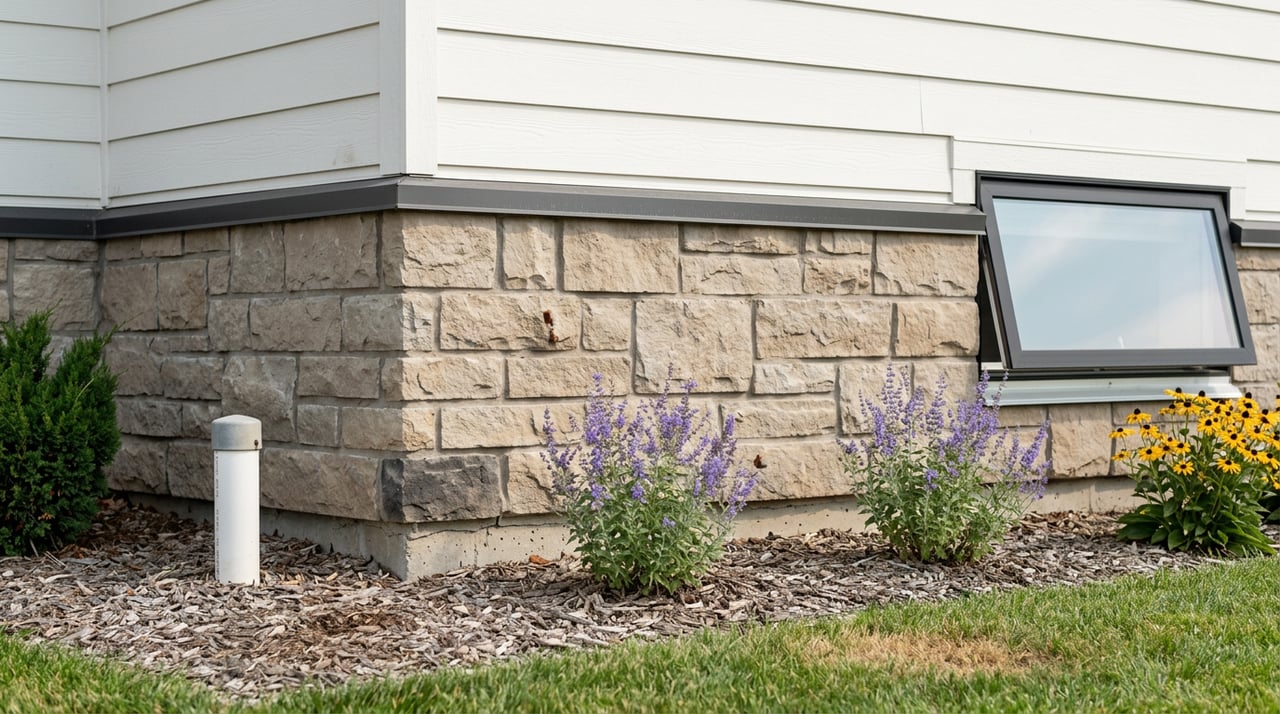
- Sub-slab depressurization for homes with a basement or slab-on-grade. A sub-slab depressurization system uses a motorized fan and PVC pipe to draw radon from the rocks and soil underneath a home and vent it outdoors, where it safely dissipates.
- Sub-membrane depressurization for crawl spaces. This technique uses a special plastic membrane to cover exposed dirt in a crawl space. The membrane is then sealed to the foundation walls. Piping installed underneath the membrane draws radon to a vent and exhausts it outdoors.
- Passive-to-active conversion in newer construction. Some Cheyenne builders rough in a passive stack during construction that can be upgraded later. Gateway provides every home they build with a passive radon mitigation system that can be easily made active if needed. If you are buying a resale from a Gateway-built neighborhood, ask specifically whether the passive stack is present, because it changes the mitigation quote substantially.
Ongoing cost is modest and worth mentioning during negotiation because sellers sometimes fixate on it. An active radon fan draws 100 to 300 watts continuously, which translates to roughly 876 kWh annually, and adds $30 to $300 to your energy bill each year.
One thing not to accept in a mitigation response: caulk. Do-it-yourself painting or caulking over cracks will not significantly reduce radon levels. A seller offering to seal foundation cracks in lieu of a real system is offering nothing.
Writing the contingency so it actually protects you
The gap between "we tested" and "the number is now defensible at closing" is where most Cheyenne radon negotiations go sideways. A few clauses do most of the work.
Ask for the test to be performed by an NRPP-certified tester, not a general home inspector running a passive kit as an add-on. Ask for a continuous monitor with a minimum 48-hour deployment under closed-house conditions. Specify that if the initial reading is above 4.0 pCi/L, the seller either installs a system by a certified mitigator with a post-mitigation retest below 4.0, or credits the buyer an agreed dollar amount at closing to install one afterward.
The credit route matters more than people realize. Sellers often prefer it because the work moves off their calendar, and buyers who accept it get to choose their own mitigator and design the system on their own timeline. It also lets the buyer request a passive-to-active upgrade quote from firms like Big Horn Radon or Certified Radon Systems before writing the credit number into the addendum, rather than after.
FAQ
Do sellers in Cheyenne have to tell me if a previous test came back high?
The seller personally is only prohibited from active misrepresentation. Their agent has the stronger duty. Under Wyoming Code 33-28-303, the agent must disclose to any prospective buyer all adverse material facts actually known by the agent. Ask the listing agent directly and in writing whether any prior testing has been done. That question puts the duty on record.
Can I use the free Wyoming Department of Health kit for my transaction?
Use it for your own information before you list, or after you close as a periodic check. For the transaction itself, order a professional test placed and picked up by a certified provider. The chain of custody is what makes the number negotiable.
Is radon worse in older Cheyenne homes than newer ones?
Age is not the primary driver. Homes can be at risk for radon whether it is new, old, well-sealed, drafty, with or without a basement. Foundation type, soil under the slab, and how much finished space is below grade matter more than year built.
Does a mitigation system hurt resale value?
The opposite, usually. A recent post-mitigation retest below 4.0 pCi/L with documentation from a certified installer is a marketing asset in a market where informed buyers already know the county is Zone 1. It also removes the item from your next buyer's inspection response entirely.
The Cheyenne read
If you are buying here from out of state, treat radon not as a paperwork exception but as your best structured question during the one window in which the seller is genuinely motivated to answer it. If you are selling, a pre-listing test from an NRPP-credentialed local firm removes a negotiating lever from the buyer's side before they ever reach for it.
Wyoming's caveat emptor rules make the inspection clause do a lot of work. A radon test is one of the sharpest tools inside that clause.
Ready to run the numbers on your Cheyenne home or the one you are about to make an offer on? Homes with Asha walks buyers and sellers through inspection strategy, mitigation credits, and the exact contingency language that holds up at closing. Get your free home value report to start the conversation.