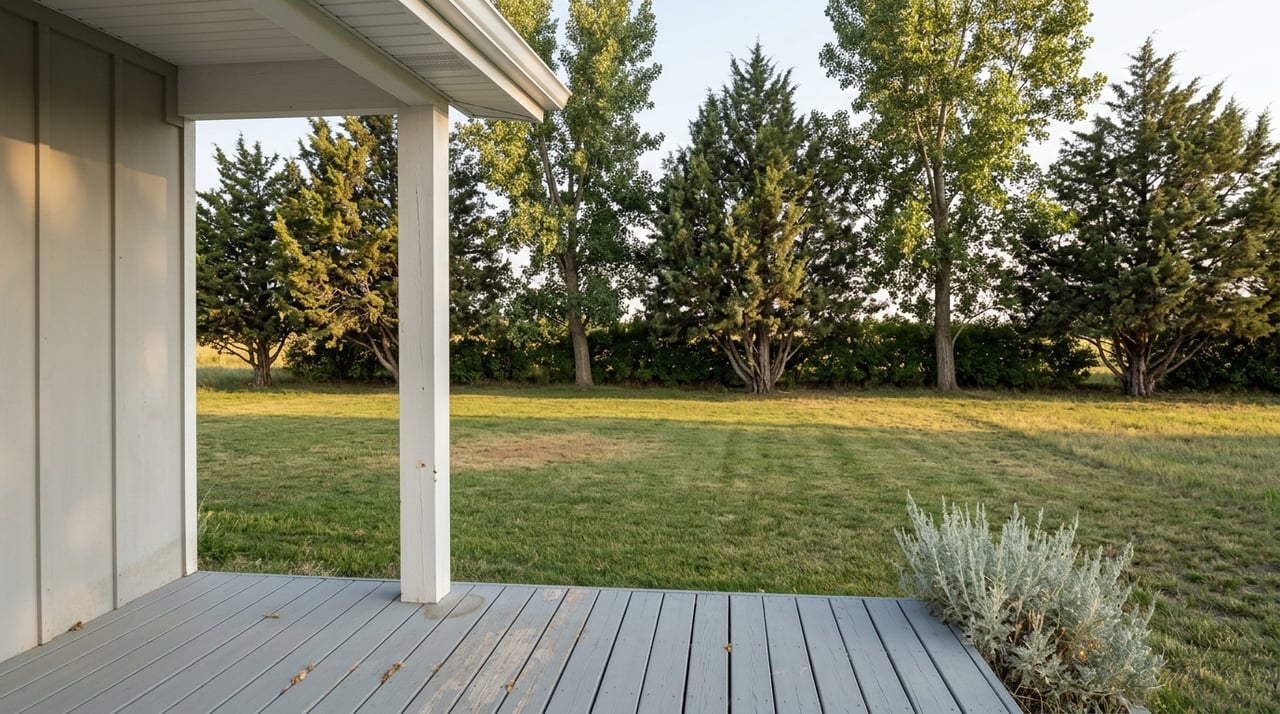
Picture two properties on the same stretch of road east of Hillsdale, maybe half a mile apart. Same soil, same view of the windbreak line, same distance to Cheyenne for a grocery run. One of them sits inside a five-mile radius of a staffed fire station. The other sits just outside it. On paper they look like the same purchase. In an insurance underwriter's system, they are not remotely the same risk, and the gap in what each owner pays to insure the house can run into hundreds of dollars a year before anyone has touched a shingle or a stick of siding.
That line exists right now, quietly, on a map most buyers never see. Tomorrow, Tuesday, August 18, it has a real chance of moving.
Laramie County voters go to the polls for the primary election with a Sixth Penny Specific Purpose sales tax ballot in front of them, 14 propositions covering everything from street repairs to a new pool in Cheyenne. Buried inside Proposition 7, the public safety measure, is a line item that matters more to anyone shopping near Hillsdale than almost anything else on the ballot: $5,543,716 for Laramie County Fire District #6 to build a new fire station and headquarters near Hillsdale. FD #6 already operates stations in both Burns and Hillsdale, with addresses on Main Street in each town.
That number is not decoration. It is the kind of capital investment that can eventually shift which side of the five-mile line a given parcel falls on, and the five-mile line is the actual mechanism insurance companies use to price a rural home. Most buyers find this out the hard way, after they are already under contract, when a quote comes back higher than they budgeted for. This is the friction worth understanding before you write an offer, not after.
What's Actually on Tomorrow's Ballot
The Sixth Penny tax is a specific purpose sales tax that only exists to fund the exact projects voters approve, and it stops collecting once the approved total is raised. Laramie County last ran one in 2021, and collections wrapped up in March of this year, which is part of why this vote carries some urgency. County Commission Chairman Gunnar Malm has framed the new $170 million ballot as an attempt to read where the community actually is right now, and Proposition 7 alone represents $16,976,216 in public safety funding split across multiple fire districts, dispatch, and emergency management.
There is a second layer to why this particular vote matters more than a typical infrastructure ask. Wyoming's fire districts are largely funded through property taxes, and a recent 25 percent residential property tax reduction, while a relief for homeowners, has put real pressure on the special districts that depend on that revenue. Local fire officials have pointed out that this is a problem facing every county fire district, not just one, which is part of why Sixth Penny support has become close to necessary for districts trying to keep pace with equipment and facility needs rather than optional icing on an already healthy budget.
If Proposition 7 passes, FD #6 gets the funding to build. If it fails, the district goes back to looking for another funding path, or waits for a future Sixth Penny cycle to ask again, and the current station configuration, and the insurance math tied to it, stays exactly as it is until that happens.
The Rule Nobody Explains at the Closing Table
Homeowners insurance for rural property is not priced off a single wildfire risk score. A large piece of the math comes from something called a Public Protection Classification, or PPC, issued by the Insurance Services Office. ISO assigns every fire protection area a number from 1 to 10. A 1 is exemplary. A 10 means the area's fire suppression program does not meet minimum criteria at all. Wyoming currently has no fire departments holding a Class 1 or Class 2 rating anywhere in the state, which tells you how rare the top of that scale really is even in well-funded districts.
Here is the part that catches rural buyers off guard: PPC is not a sliding scale based on how far you live from town. It is a hard cutoff at five road miles from a staffed station, and that cutoff creates two very different insurance realities on either side of it.
Laramie County Fire District #1, which serves the area right around Cheyenne, sits at Class 3 for anything within five road miles of its stations and drops to Class 4 outside that radius, the same rating Cheyenne Fire Rescue itself carries. Laramie County Fire District #10 tells an even starker version of the same story. After its 2019 ISO audit, it received a split classification of 8B for structures within five road miles of either of its two stations, and a Class 10, the bottom of the scale, for anything beyond that.
| District | Within 5 road miles | Beyond 5 road miles |
|---|---|---|
| Laramie County Fire District #1 | Class 3 | Class 4 |
| Laramie County Fire District #10 | Class 8B | Class 10 |
Wyoming's Deputy Insurance Commissioner Tana Howard put the underlying logic plainly earlier this year when she spoke about what actually drives cost for rural policyholders:
"The cost of a home depends on when it was built, how it was built, what codes, where it's at, obviously a home in town has a little less risk if it's sitting right next to a fire station, as opposed to something 30 miles out of town that is a long ways from a fire station or any type of water hydrant."
That last phrase matters too. PPC also weighs whether a property has a creditable water source within 1,000 feet of the home, which is its own separate hurdle for anyone on well water with no hydrant nearby, a common situation for acreage around Hillsdale.
A new station and headquarters funded by Proposition 7 does not automatically hand anyone a lower number. ISO has to re-audit a district after it changes staffing, apparatus, and station locations, and that process takes time. But FD #1's own improvement to Class 3 came from exactly this kind of investment paying off over time, and a new, better-placed station is precisely the sort of capital upgrade that shows up favorably the next time ISO comes back around.
What This Means If You're Looking Near Hillsdale
Before you write an offer on a rural or acreage property near Hillsdale, a few questions are worth asking that most buyers skip entirely:
- Ask the seller's agent, or call the fire district directly, for the parcel's current PPC classification. Many rural Wyoming districts do not publish this number online, but ISO provides it to the district free of charge on request, and the district can share it with you.
- Confirm the distance is measured in road miles, not straight-line miles, since that is the standard ISO actually uses, and rural roads rarely run in a straight line to the nearest station.
- Get an insurance quote tied to the exact parcel address before you're locked into a contract, not after. Two properties a half mile apart, on opposite sides of that five-mile line, can carry noticeably different premiums for the identical structure.
- Ask whether the district has funding in motion for a new or relocated station, since a change like the one on tomorrow's ballot can eventually redraw where that five-mile radius falls.
- Ask about water supply too. A hydrant or a certified water source within 1,000 feet of the home changes the classification independently of distance to the station.
None of this replaces a conversation with an actual insurance agent who can run numbers on the specific address. But walking into that conversation already knowing the mechanism means you are asking the right question instead of just reacting to whatever quote lands in your inbox.
FAQ
Does passing Proposition 7 guarantee lower insurance for Hillsdale-area homes? No. It funds construction. Any change to the PPC classification requires a separate ISO audit after the new station is built and staffed, which takes time beyond Tuesday's vote.
What happens to FD #6 if the measure fails? The funding does not appear elsewhere automatically. The district would need another funding path or a future Sixth Penny cycle, and the current station setup, and the insurance math tied to it, stays in place until that happens.
How do I actually find a specific parcel's PPC class? Contact the fire district that covers the property directly. ISO shares classification reports with the district at no charge, and most departments will provide the number on request even if it is not posted publicly.
Does the five-mile rule only apply out in the county, or does it matter for in-town properties too? It matters most for rural and acreage parcels, since in-town properties are almost always well within the radius of a staffed station. The classification gap becomes real once you are looking at property that starts to stretch toward that outer edge, which describes a lot of the land around Hillsdale.
If you are looking at acreage or a rural home near Hillsdale and want a straight answer on where a specific parcel actually sits relative to that five-mile line before you write an offer, reach out to Homes with Asha. And if you already own property out that way and are curious what tomorrow's vote could mean for what you have, ask for a free home value report while you're at it.