Search "Laramie County, Wyoming land for sale" on three different land-listing aggregators and you will get three different countywide numbers. As of August 2026, one site puts the median at $15,126 an acre. Another averages current listings out to $18,456. A third lands at $43,807, nearly triple the first figure, for what is supposed to be the same county on the same map.
None of those numbers is wrong. They are just measuring different things, and the difference matters a great deal if you are looking at acreage out toward Carpenter, the unincorporated farm community tucked into the far southeastern corner of Laramie County, a couple of miles from the Colorado line. The countywide average was never built to describe a place like Carpenter. It was built by blending everything from five-acre ranchettes near Cheyenne to multi-thousand-acre working ranches, and the blend hides more than it reveals.
Why the same county produces three different averages
The gap comes down to one variable: how big the parcels in each dataset happen to be.
One aggregator's Laramie County figures work out to an average parcel size near 12 acres, once you divide the average listing price by the average per-acre cost. Another's implied parcel size lands closer to 58 acres. A third, built around a smaller pool of listings with an average lot size of 158 acres, produces the lowest per-acre figure of the three. Smaller parcels consistently carry higher per-acre price tags than larger ones, because the fixed costs of getting land ready to build on, road access, a survey, utility hookups, don't shrink just because the parcel does. Spread those costs over 10 acres and the per-acre number balloons. Spread them over 500 acres and it barely registers.
That is the mechanism, and it is not unique to Wyoming. A land-market breakdown of the Cheyenne-Laramie corridor put it plainly: this stretch of the state has "mixed drivers, some agricultural, some commuter and development demand," and that mix "often create[s] wide spreads in per-acre pricing." The same analysis notes that smaller tracts routinely sell for a higher per-acre number while large ranches trade at a discount per acre, simply because the total purchase price gets so large that buyers negotiate the per-unit cost down.
What a real listing near Carpenter's corridor actually shows
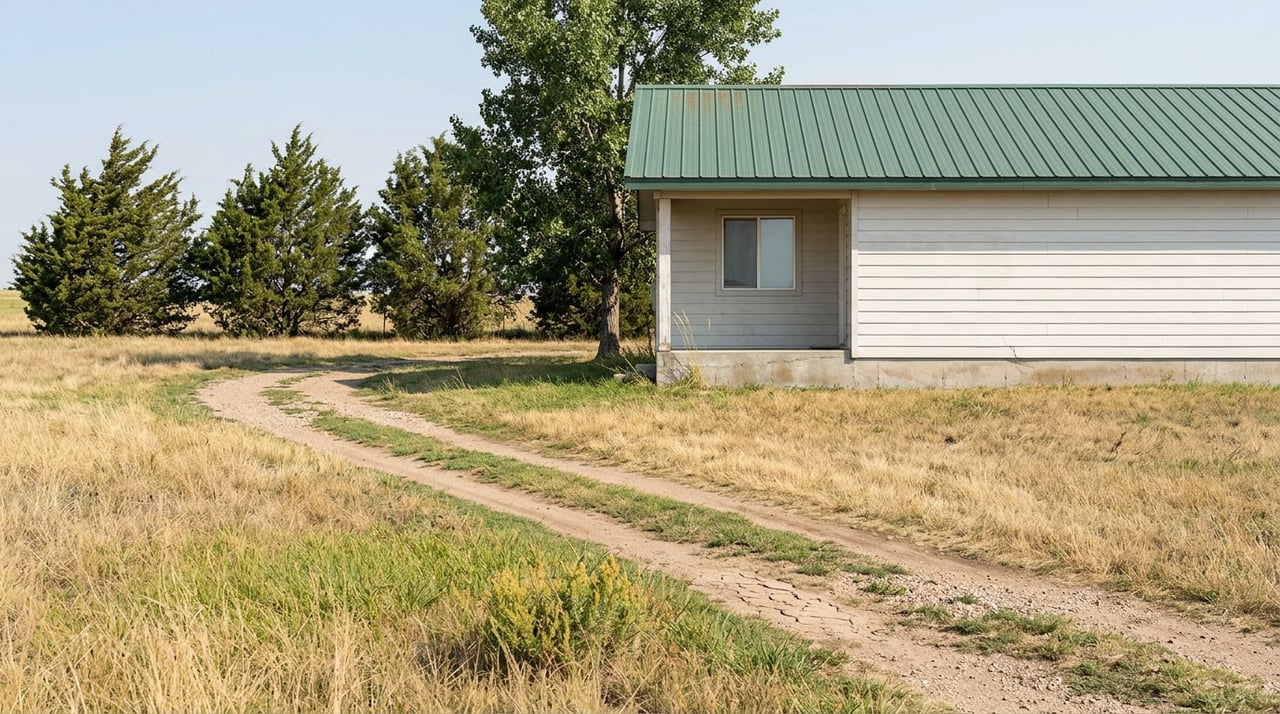
Averages are one thing. Actual listings tell you more. In eastern Laramie County, a short drive up the road toward Pine Bluffs, a 240-acre tract listed as of August 2026 at $444,000, which works out to roughly $1,850 an acre. That is nowhere close to any of the three countywide averages above. It is straight dryland acreage with no home, no subdivision name, no proximity story to sell, just grass and highway access.
Compare that to two other Laramie County listings closer to Cheyenne. A 77-acre parcel known as the Hume 80 sits just north of the city, close enough that road access and electricity availability are the selling points. A 160-acre tract 17 miles northeast of Cheyenne borders a platted subdivision called Skyview Estates, a name that signals development intent rather than grazing capacity. Neither of those listings publishes a price in the data available, but their framing, proximity to town, adjacency to an estates-style subdivision, tells you which side of the commuter-versus-agricultural divide they sit on. Carpenter, by contrast, sits on the agricultural side of that divide almost entirely.
| Example | Location | Deeded acres | What it tells you |
|---|---|---|---|
| Peoples Company tract | Eastern Laramie County, near Pine Bluffs | 240 | Priced at roughly $1,850/acre, well below every countywide average, because it's straight working land with no commuter premium |
| Hume 80 | Just north of Cheyenne | 77 | Priced for road and utility access near town, not for grazing capacity |
| Skyview Estates-adjacent tract | 17 miles northeast of Cheyenne | 160 | Borders a named subdivision, signaling development value rather than agricultural value |
The lesson for someone pricing acreage near Carpenter isn't that land there will cost $1,850 an acre. It's that the countywide averages you'll see on any listing aggregator are being pulled upward by tracts that have nothing in common with Carpenter's economics, and pulled around further by parcel-size mixing that has nothing to do with location at all.
Carpenter still prices like working land, and the numbers back that up
Laramie County is not a marginal agricultural county. According to a Cowboy State Daily breakdown of the most recent USDA agricultural census, conducted in 2022, Laramie County ranked second in the state for value of agricultural production, at $162.7 million, trailing only neighboring Goshen County. Combined with Platte County, the three counties that make up Wyoming's southeastern corner accounted for roughly $469 million in agricultural output. That is the economic backdrop Carpenter sits inside of, and it is a working economy, not a commuter suburb waiting to happen.
State and national benchmarks for that kind of land give a useful floor. U.S. pastureland averaged $1,920 an acre in 2025, up about 4.9 percent from the year before, according to USDA figures cited in land-market reporting. U.S. farm real estate broadly averaged $4,350 an acre in 2025, up 4.3 percent year over year, per the American Farm Bureau Federation. Wyoming typically prices below the national average on strictly agricultural metrics. Set against that, the $1,850-an-acre Pine Bluffs-area tract isn't an anomaly. It's close to where working pasture in this part of the state should land.
There's a wilder piece of evidence for how far this corner of the county still sits from suburban pressure. In January 2026, a rancher near Carpenter shot a wolf on his own property, an animal wildlife officials said may be the first legally taken wolf ever recorded in Laramie County. The shooting happened about two and a half miles north of the Wyoming-Colorado line, close enough that officials floated the possibility the animal wandered up from Colorado's wolf reintroduction program. Whatever its origin, the story only makes sense in a place where ranchers are still actively managing predators around cattle. That is not incidental color. It is the same working-land reality that keeps per-acre pricing anchored near agricultural benchmarks rather than commuter-belt ones.
What to check before you trust any per-acre number
If you're comparing acreage near Carpenter against something closer to Cheyenne or along the I-80 corridor near Pine Bluffs, a few questions will tell you more than any published average:
- How many of the acres are deeded versus leased. Rural listings sometimes bundle deeded acreage with adjoining BLM or State Trust leases to advertise a bigger total acreage figure. Only deeded acres transfer with full ownership rights, so the true per-acre cost of what you're buying can look very different once leased ground is stripped out.
- Whether water rights are attached. Irrigated cropland and dry pasture trade on different economics entirely, and a parcel's water rights, or lack of them, can matter more to its value than its acreage.
- How close the tract sits to an existing subdivision or utility corridor. A name like Skyview Estates on a neighboring parcel is a signal in itself. Land near an established or platted development tends to carry pricing closer to the higher end of the countywide range, while standalone agricultural ground further out does not.
- How the county assessor classifies the parcel. Laramie County, like the rest of Wyoming, taxes agricultural land based on its productivity capability under normal conditions rather than its market value. That means the assessed value you'll see on the tax roll can look nothing like the number a listing agent quotes, and it's worth understanding which figure you're actually negotiating against before you make an offer.
Carpenter's own history reinforces the pattern. It was founded in 1907 as a stop on the old Chicago, Burlington and Quincy rail line that ran from Hereford, Colorado up through Carpenter to Cheyenne, named for a land developer, James R. Carpenter, whose company opened 146,000 acres of Wyoming land to settlers. It has stayed a farming and ranching community since, and its land economics have never really tracked with Cheyenne's growth the way land closer to the city has.
The bottom line for a Carpenter-area buyer
Treat any single "Laramie County price per acre" figure as a starting question, not an answer. Ask what parcel sizes went into it, ask whether the tracts near your search are closer to a subdivision or closer to open pasture, and price against agricultural benchmarks rather than countywide portal averages when you're looking this far from Cheyenne. The number that matters is the one specific to the parcel in front of you, not the blended average built from parcels on the other side of the county with a completely different buyer pool.
If you're weighing acreage near Carpenter against options closer to Cheyenne, Hillsdale, or Pine Bluffs, Homes with Asha can walk you through what a specific parcel's numbers actually mean before you write an offer. Get your free home value report to start the conversation.